
Is acrylic good for knife handles?
Choosing a knife handle material is not only about finding the strongest option. A good handle must meet structural and grip requirements while also fitting the overall design of the knife.
G10 and Micarta have long served working knives, outdoor knives, and other applications where durability and grip matter. Stabilized wood, horn, bone, and other natural materials remain popular for their distinctive grain and traditional character.
Decorative cast acrylic takes a different approach. Instead of competing with these materials on the same criteria, it gives knife makers another way to work with color, pattern, and visual identity.
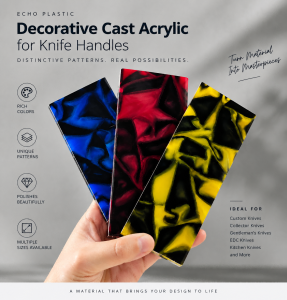
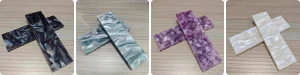
For custom knives, collector knives, gentleman’s knives, EDC models, and some kitchen knives, the handle often forms an important part of the design. Decorative cast acrylic works particularly well in this role. It can create pearl, swirl, cloudy, tortoiseshell-inspired, translucent, metallic, and stone-like effects.
The result sits between completely uniform synthetic materials and highly variable natural materials. Makers get visual variation while still working within a recognizable color and pattern family.
Why Pattern Variation Matters in Acrylic Knife Handles?
Pattern variation is one of the defining characteristics of decorative cast acrylic.
Many decorative patterns do not come from printing or mechanical repetition. Instead, different colors, pearlescent materials, and decorative components are introduced manually during production. This process naturally creates variation across the material.
As a result, pieces from the same pattern family can share the same overall color direction without carrying identical markings.
For knife makers, this gives each finished handle its own appearance. For distributors, it creates an opportunity to build a product range around a recognizable style without making every piece look exactly the same.
Customers should therefore view product photos as a representation of the color and pattern family, rather than an exact copy of every piece they will receive.
How Shaping Changes the Appearance of Patterned Acrylic?
Knife-handle applications differ from ordinary decorative sheet applications in one important way: the material does not stay flat.
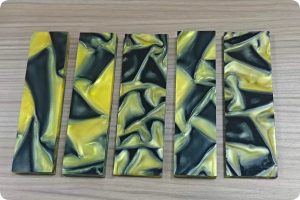
A maker cuts, contours, rounds, sands, and polishes the blank during production. As the shape develops, colors and patterns inside the material can become more visible.
This effect matters especially with pearl, swirl, translucent, and multicolor designs. Curved surfaces also interact with light differently from flat sheets, which can add more depth to the finished handle.
For this reason, a front-facing photograph tells only part of the story.
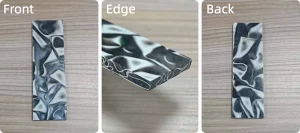
Knife makers and professional buyers should also look at the reverse side, cut edge, and visible pattern through the thickness. These views give a better idea of how the material may look after shaping.
Manually created patterns can also look different on the two faces. This variation is normal. The important question is whether the overall pattern works with the intended handle design.
For distributors, showing the front, back, and edge can therefore provide more useful information than showing only a polished front surface.
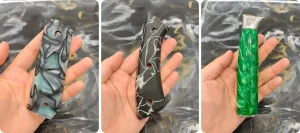
Display of finished acrylic knife handles
Decorative acrylic does not need to replace G10 or Micarta.
G10 and Micarta have earned strong positions in the knife industry because they offer useful structural properties, durability, and grip. These qualities make them especially relevant to working and outdoor knives.
Decorative acrylic serves a different design priority. It can provide pearl movement, translucent depth, tortoiseshell-inspired patterns, unusual color combinations, and a high-gloss finish.
These characteristics make acrylic particularly interesting when the visual character of the handle contributes to the value of the finished knife.
Instead of asking which material is simply “better,” makers should consider what the knife actually needs. A working knife and a collector’s knife may require very different handle materials.
What Should Knife Makers Know About Machining Cast Acrylic?
Cast PMMA can be sawn, drilled, milled, sanded, and polished with established plastic-fabrication methods. However, makers should not process it exactly like wood, G10, or metal.
PMMA is relatively rigid and is also a thermoplastic. Heat buildup and local stress therefore deserve attention during fabrication.
Sharp tools and stable workpiece support help create more controlled cutting conditions. Makers should also avoid unnecessary heat buildup and overly aggressive machining. Progressive sanding is important when preparing the surface for polishing.
Pin holes, thin edges, and detailed contours require additional care because these areas can concentrate stress.
There is no single machining parameter that works for every acrylic handle material. Machine type, tool geometry, material thickness, hole diameter, and processing method can all affect the result.
Professional makers and manufacturers should therefore test sample material with their own equipment before regular production. This approach is more useful than relying on one universal drilling speed or CNC feed rate.
For the same reason, material suppliers should avoid simply describing acrylic as “easy to machine.” Clear information about thickness, pattern structure, and available formats gives professional buyers a better basis for their own evaluation.
What Should Knife Handle Material Distributors Consider?
For distributors, an attractive pattern is only the beginning.
A material also needs to work as a long-term product. Distributors should consider whether they can restock the same general color and pattern family. Practical thicknesses and suitable supply formats also matter.
Different customers may need different formats.
A hobby maker may prefer pre-cut blanks. A professional knife maker may want larger pieces to gain more freedom when selecting pattern areas and cutting dimensions. A material distributor may choose full sheets or slabs and convert them locally into different SKUs.
This flexibility allows decorative acrylic to enter the knife-making supply chain at several stages:
Decorative Acrylic Sheet → Handle Slab → Custom-Cut Blank → Knife Scale
Larger formats give distributors more control over cutting dimensions, pack quantities, product combinations, and SKU structure.
Many natural handle materials depend on the dimensions of the original raw material. Cast acrylic offers more flexibility in this part of product development.
Building a Knife Handle Material Range Around Color and Pattern
For distributors, the next opportunity goes beyond selling individual patterns.
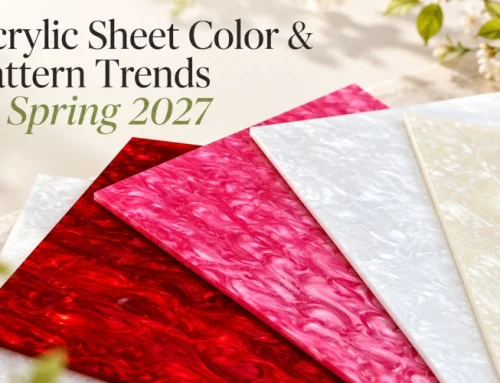
Color and pattern can become the basis of a complete material range. A distributor might develop pearl collections, dark swirl collections, tortoiseshell-inspired collections, translucent collections, or groups built around a specific color direction.
Individual pieces do not need identical markings. Instead, the collection needs a recognizable visual direction and a reliable supply basis.
This approach makes decorative acrylic easier to manage as a long-term SKU rather than as a one-off decorative stock item.
It also gives distributors more room to develop products for different customer groups. They can combine specific patterns with selected thicknesses, blank dimensions, or larger slab formats.
Decorative Cast Acrylic from Echo Plastic
Echo Plastic supplies decorative cast acrylic in pearl, swirl, tortoiseshell-inspired, and other patterned effects.
Many of these patterns use manual material feeding during production. Natural variation therefore appears between sheets and across different areas of the same sheet.
For this reason, we recommend viewing these materials as Color & Pattern Families rather than expecting every piece to repeat the same design.
Depending on the buyer’s requirements, we can supply larger sheet formats or convert the material into sizes suitable for knife-handle applications. This gives knife makers, manufacturers, and material distributors more flexibility in processing and product development.
If you are developing an acrylic knife handle material range or looking for distinctive patterns, thicknesses, or custom sizes, Contact Echo Plastic to discuss available materials and sourcing options.
Related Products